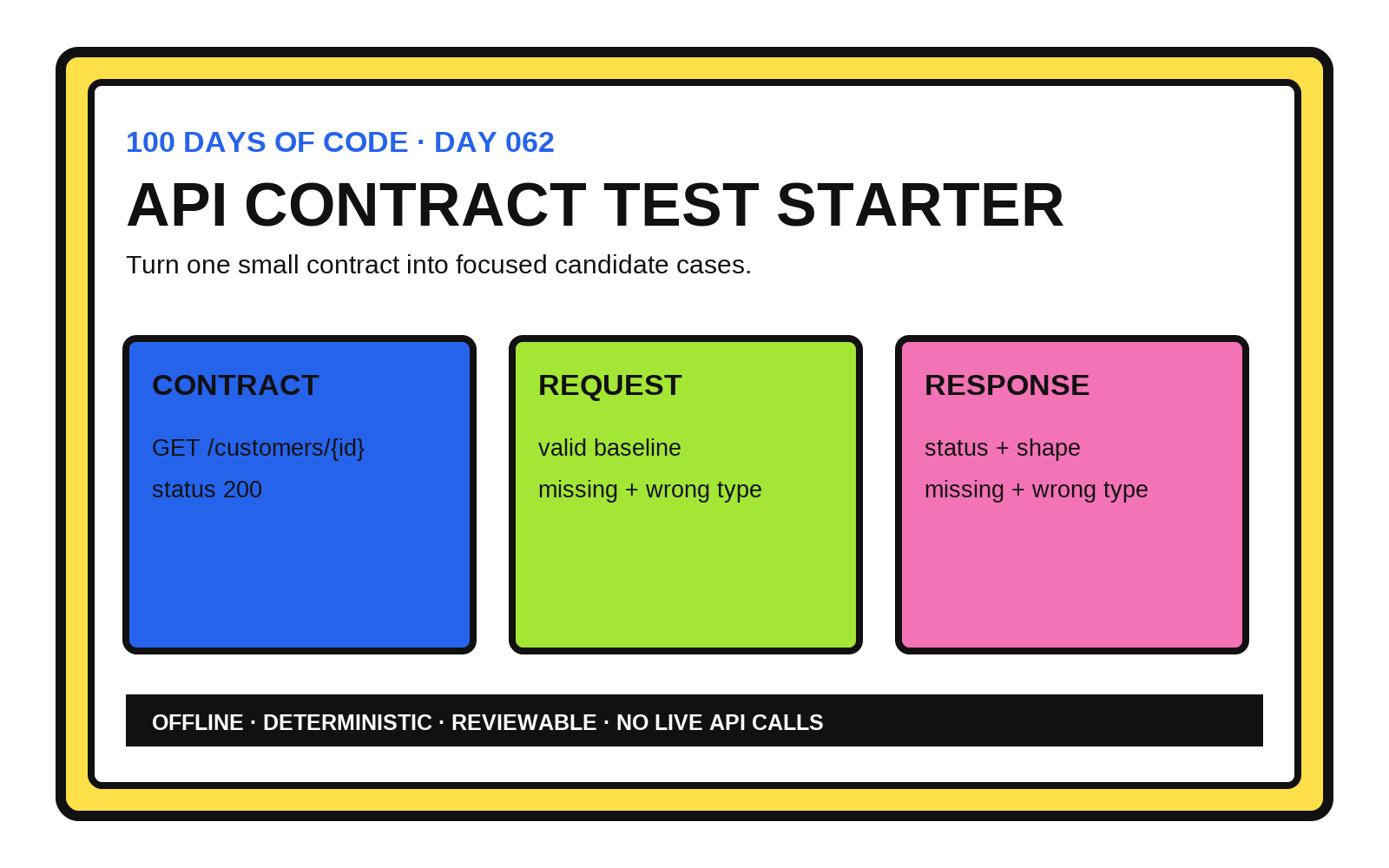
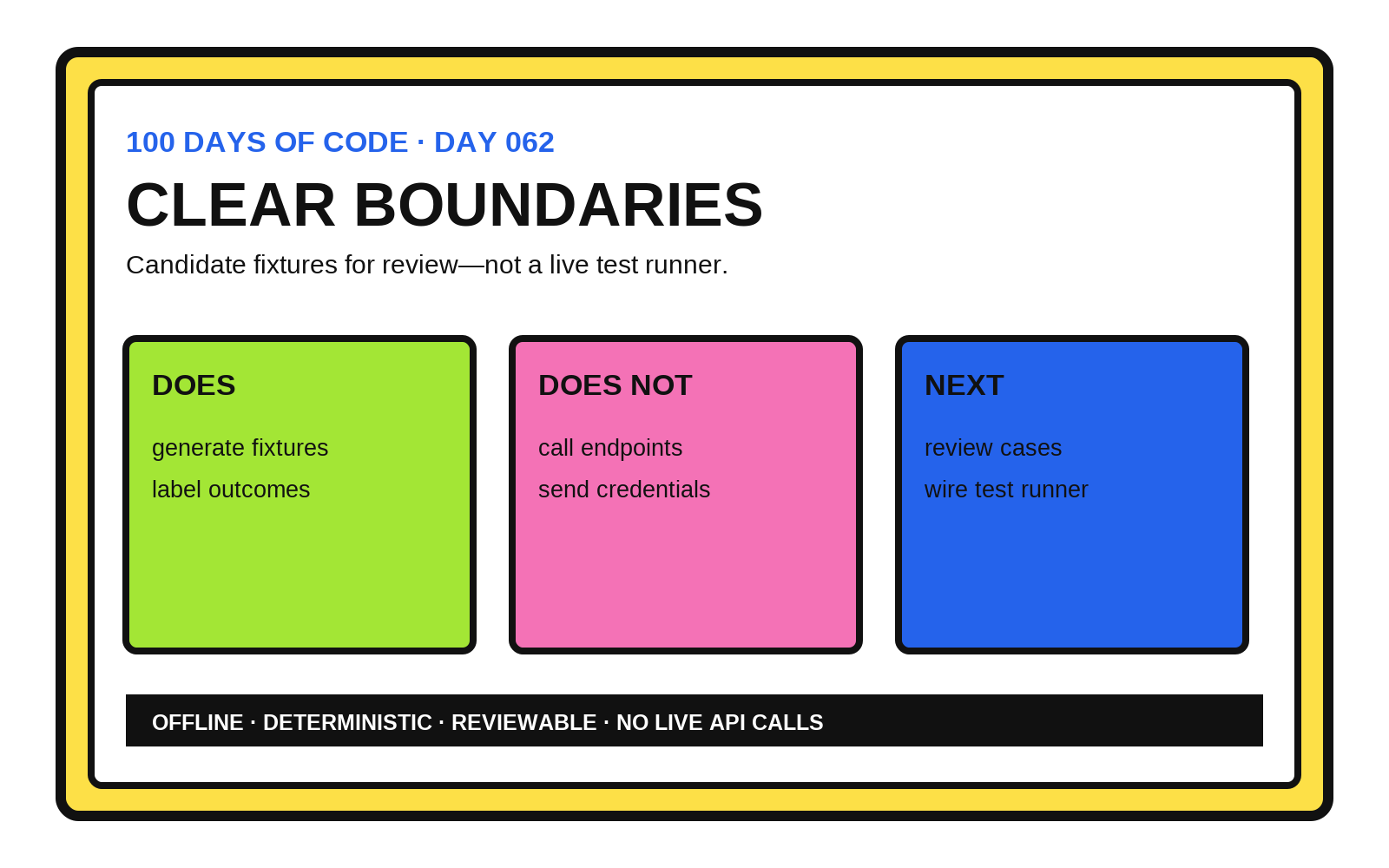
A dependency-free Python CLI that turns a small API contract into deterministic request and response test candidates without calling a live endpoint.
NameAPI Contract Test Starter
ClientIndependent daily build
IndustriesSoftware quality tooling
DateDay 062 · October 31, 2026
/ Challenge
An API contract is easy to describe at a high level but repetitive to translate into a balanced first set of positive and negative cases. Handwritten starters can overlook required parameters, type mismatches or response-shape failures, while testing against a live endpoint too early can introduce credentials and real data.
/ Provided services
Clear thinking. Practical delivery.
01
Contract preflight
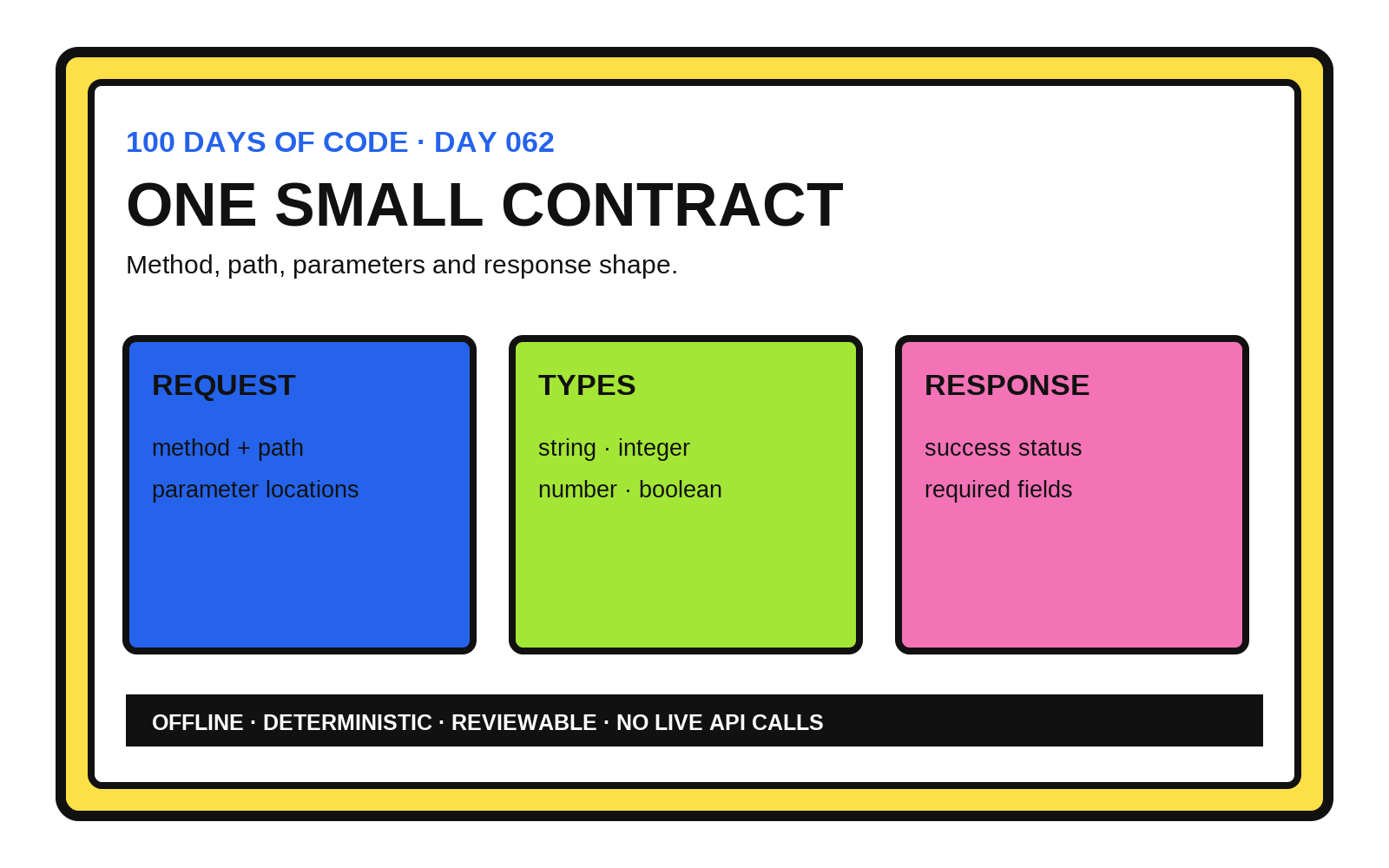
A compact definition records the method, path, parameter locations, examples, success status and required response fields.
02
Balanced starter cases
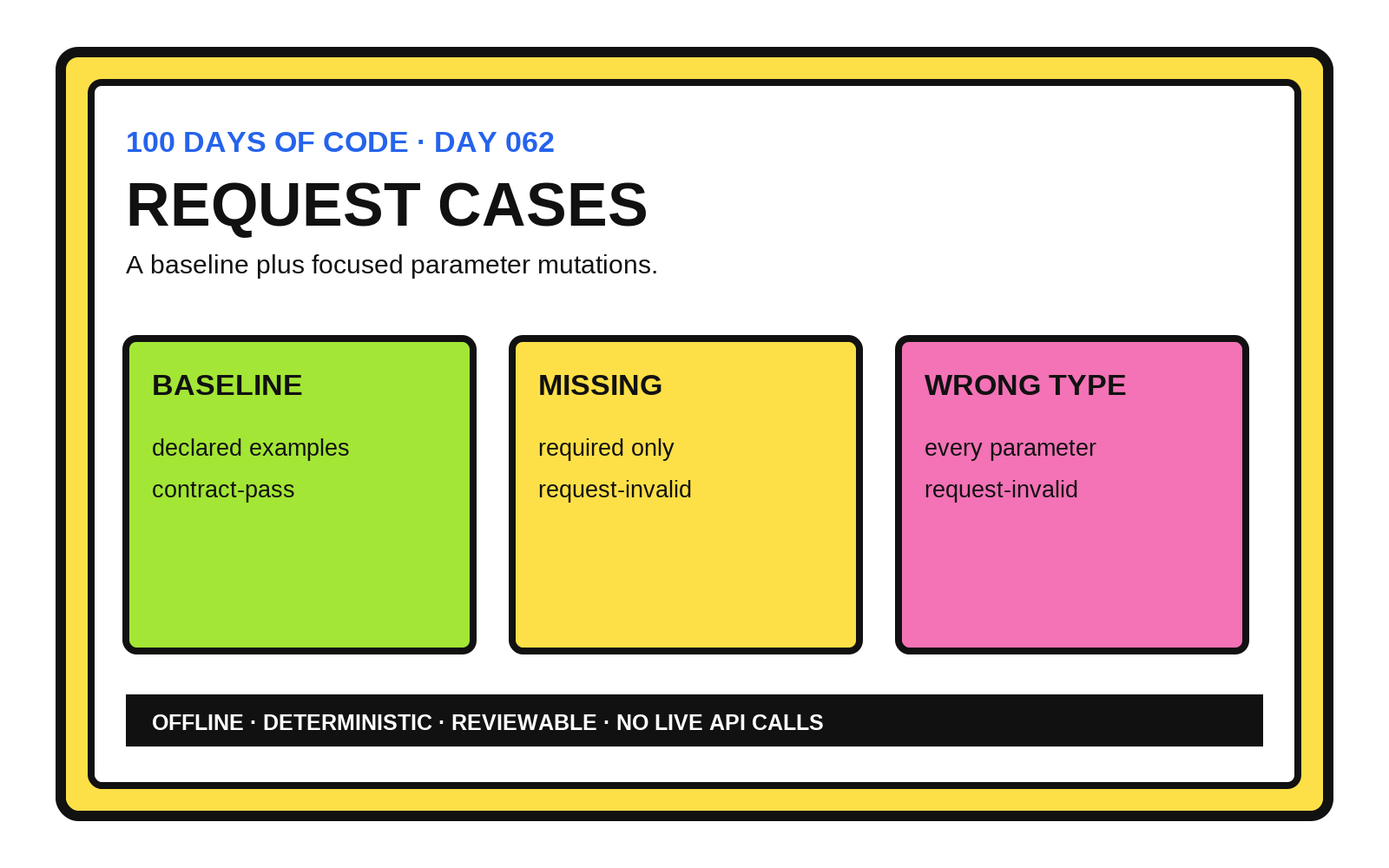
The generator pairs one valid baseline with focused negative mutations and labels the expected contract outcome.
03
Offline boundary
No network request, credential, authentication header or production response is needed to build the candidate plan.
/ Solution
API Contract Test Starter validates one bounded local JSON contract and generates a stable baseline plus missing-required-parameter, wrong request type, unexpected response status, missing response field and wrong response type cases. It supports common HTTP methods, four parameter locations and seven JSON value types, with duplicate-key, duplicate-name, unknown-field, invalid-example and size checks. It creates reviewable candidate fixtures only; it does not call an API, send credentials, generate personal data or prove an endpoint is correct.
/ Impact
Valid baseline fixture
Required-parameter omissions
Request type mutations
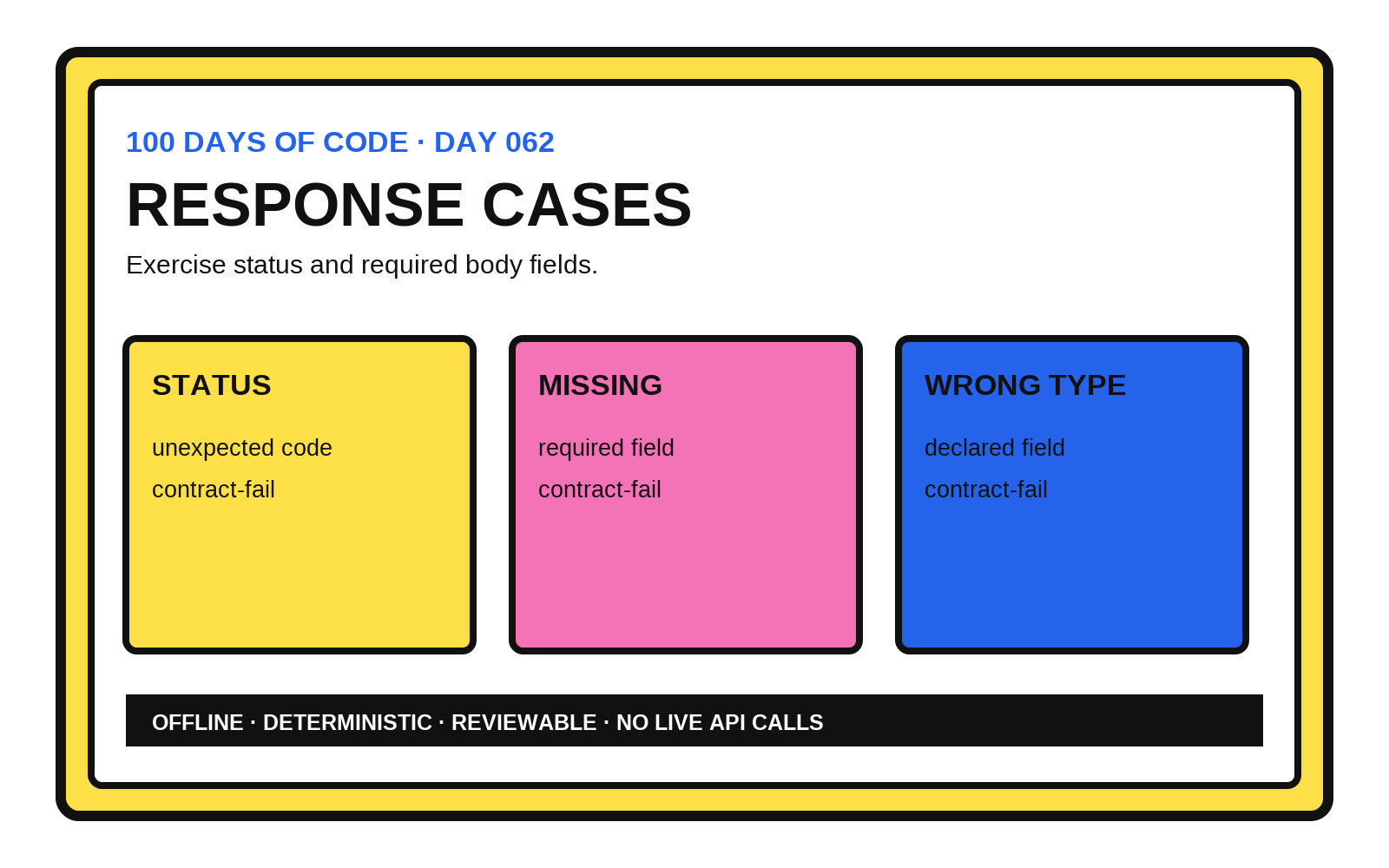
Response status mutation
Response field and type mutations
/ Tech stack
Python standard library
Argparse, JSON, pathlib and unittest keep the CLI portable and dependency-free.
Defensive contract model
The parser rejects duplicate keys and names, unsupported fields and types, invalid examples and oversized inputs.
Twelve tests
Tests cover deterministic ordering, positive and negative cases, type semantics, duplicate data and invalid contract shapes.