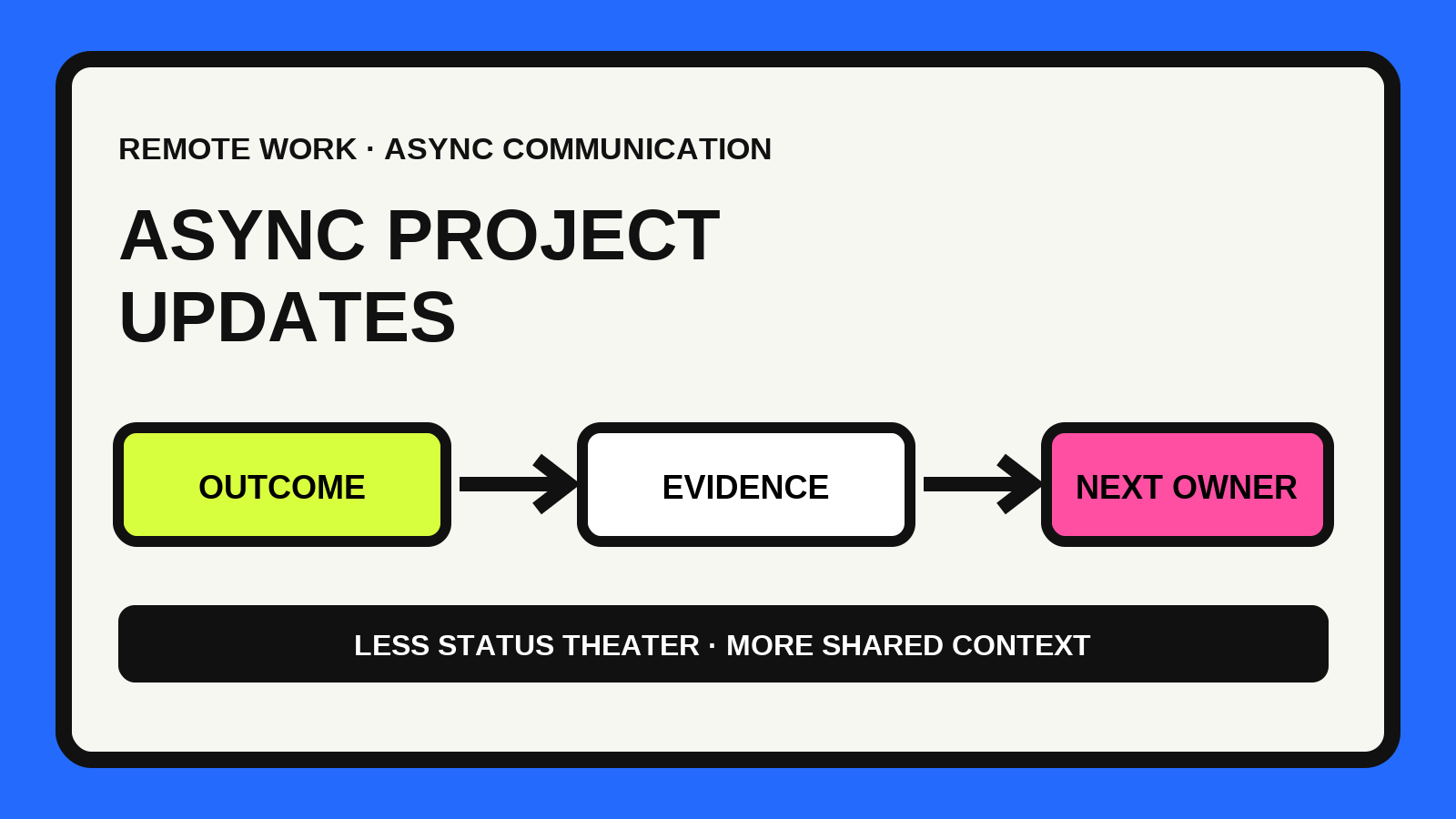
The problem: an update that leaves work unclear
A message can list hours of effort without explaining what changed, what is still incomplete or who should act next. A teammate reading it later has to reconstruct the status from chat and scattered links.
An async project update should stand on its own. Its job is to reduce uncertainty for a reader who was not present, not to document every activity or replace every conversation.
The concern: vague status becomes a false handoff
“Done” can mean coded locally, tested, reviewed or already live. If the environment and evidence are missing, a reader may make a release decision on a claim the writer did not intend.
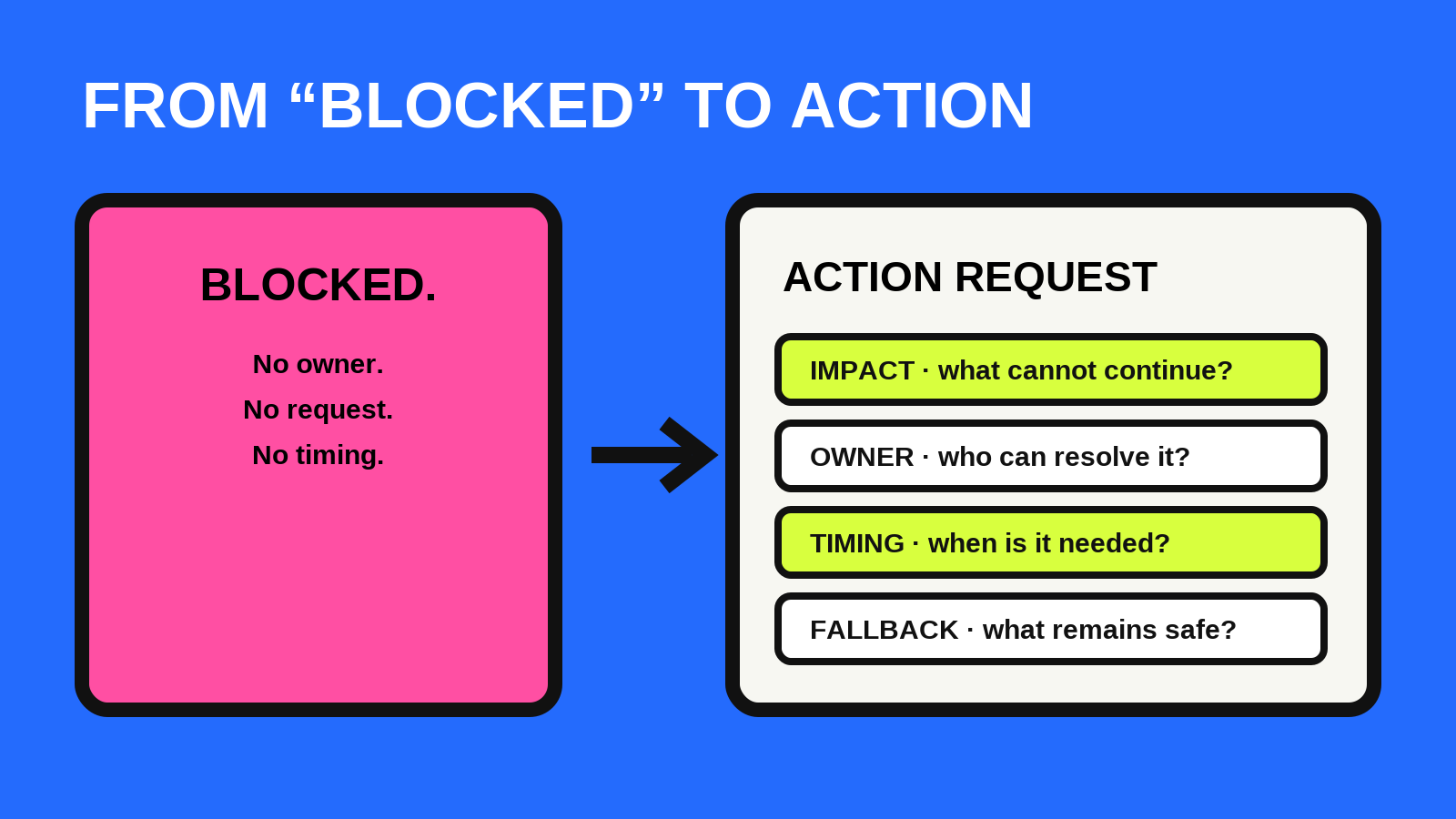
Ownership can be just as unclear. “Waiting for review” is not a useful handoff when nobody knows which review, by whom or when a decision is needed. Preserve the boundary between completed work, remaining checks and permission to release.
Where it applies: remote reviews and handoffs
This format suits routine project status, design reviews, development handoffs and work crossing time zones. It is especially useful when the next person will read the record after the writer is offline.
- Contributor: explain the observable outcome and its limits.
- Reviewer: link the exact item and state what needs checking.
- Decision owner: show the question, options and latest useful decision time.
- Next operator: identify the action and any prerequisite.
- Urgent or sensitive matter: use the agreed live or private escalation path instead of relying on an unattended update.
Example scenario: a preview is ready, mobile review is not
In a fictional project, an update says: “The new case study renders on preview. Evidence: the review PR, preview link and content-check result. Current state: copy reviewed; mobile layout still needs inspection. Blocker: none. Next: the design reviewer checks mobile by the agreed review date; the release owner then decides whether to merge.”
The example claims only a preview result. It does not turn passing content checks into production approval. A reader can identify the evidence, unfinished work and next decision without replaying the conversation.
Resolution: use the same five-part record
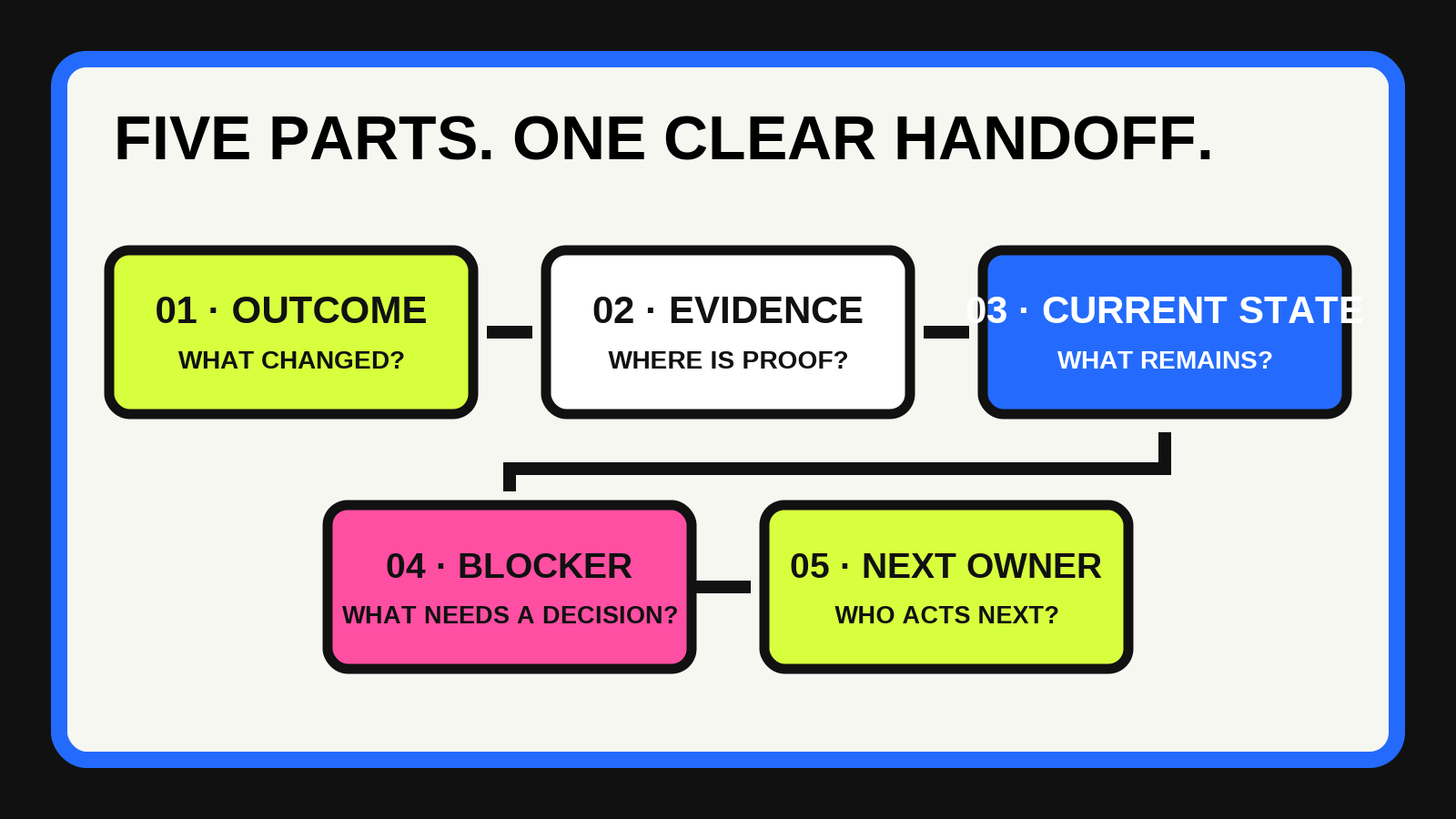
Begin with the outcome in one sentence. Link the evidence, identify the current state, state any blocker or decision, and name the next owner. Use explicit labels if they make the record easier to scan.
For a blocker, describe what cannot proceed, the dependency, who can resolve it and the relevant timing. Separate a current blocker from a possible future risk. Link the source record instead of copying detail into competing updates.
GitLab's public communication guidance supports written, asynchronous work and a shared source of truth. The practical recommendation here is to apply that habit to one update format, while retaining live discussion when the situation needs it.
- Outcome: what changed?
- Evidence: where can the intended reader verify it?
- State: what is complete, under review or still untested?
- Decision: what needs attention and why?
- Next: who does what, and when?
Recommendations: write for the absent reader
Before posting, read the update as someone opening it hours later. Replace activity counts with observable results and remove detail that does not change the next decision.
- Name the environment: local, preview, staging or production.
- Use accessible deep links to the exact review item.
- Distinguish facts, assumptions and unresolved questions.
- Include a date and timezone when timing matters.
- Keep secrets and private customer details out of general updates.
- Edit the source record when status changes and preserve a clear history.
Conclusion: make the next action visible
A useful update tells the reader what changed, where the proof lives, what remains and who acts next. A stable format makes that easier without turning routine communication into a long report.
Use it for the next handoff and adjust the detail to its risk and scope. Explore the projects or discuss a workflow when the handoff itself needs improvement. GitLab primary communication guidance reviewed November 18, 2026.